Project
Salvador Scholarship Program:
An overview & update
By Tony Gasbarro, Board Member and
Scholarship Coordinator
Mr. Gasbarro is coordinator of the scholarship program and can be reached
by either sending him an email by clicking on the following envelope or at 907-455-6287 for further information.
|
"An educated woman is an educated mother and, as
such, she is able to provide her children with a broad outlook. On the other
hand, an uneducated woman is an uneducated mother who cannot broaden her
children's horizons."
Haji Zeynalabdin Taghiyev (1823-1924)
|
Scholarship
students with uniforms
|
I finished my service as a Peace
Corps Volunteer in El Salvador in October 1998. As I was leaving I realized
that I could never say goodbye and wanted to stay involved
with my community. As I pondered as to what I could do the thought came to me
that the best contribution I could make would be
to enable the children to continue their education. In my village named La
Montañona, with a population of about 110, it was and
still is only possible to get a 6th grade education. So the scholarship program began in
1998 providing children, who were able to find a
family to live with in another community, with enough financial resources to
buy school supplies, uniforms, and food. During that year
the program also sponsored one girl who wanted to become a nurse and several
high school students from the town of La Laguna near to
La Montañona. In La Laguna there was a convent of Carmelite Missionary Sisters
who agreed to monitor the scholarship students.
From a small beginning of 9 students in 1998 the program has grown to about 130
students in March 2011. The program became a part of
Project Salvador in 1999. Since 1998 about 320 of our scholarship students have
graduated from high school and 8 have graduated
from Universities or post-secondary technical schools. Five of the 8
post-secondary graduates are gainfully employed. I have not been
able to ascertain how many of our high school graduates have found work.
|
Karenina
a Masters Degree student in primatology using donated computer
|
The primary focus of the scholarship
program is impoverished, young women from rural areas. About 75 percent of all
the scholarship recipients are women. In rural areas
of El Salvador, in families with limited financial resources, the boys are
given the opportunity first to go to school particularly when
students enter high school where the families have to provide their children
with uniforms and school supplies and bus fare to distant
high schools. Girls are often expected to stay at home to help care for younger
siblings, cook, wash and gather fuel wood. During the last 15
years interacting with rural families in El Salvador, I have noticed that
parents have begun to realize that girls need at least a high
school education and are willing to allow them to complete high school if there
are sufficient financial resources.
|
Johanna
at her home in San Chico El Salvador.
She wants to become a doctor
|
Project Salvador works with two
Salvadoran NGOs, the Carmelite Missionary Sisters, the Sisters of Charity, and
two community leaders to help carry out the
program in El Salvador. These organizations help select the students, monitor
their progress, and purchase school supplies, uniform materials,
and shoes. In some cases they disburse cash to cover transportation costs and
university fees.
“I may not be able to find employment
with my high school diploma
because of our poor economy
but at least I’ll be a better mother”.
High
School Student,
La
Laguna, El Salvador
|
Marvin
a polio handicapped student is studying law.
|
Never are the students given a lump sum
payment for their scholarship. Small amounts of money are disbursed on a
monthly basis. One hundred percent of the donations received
for the scholarship program go to program expenses. Fundraising expenses and
administrative services related to the scholarship program
are donated by board members. Our total disbursements this year to the
scholarship program in El Salvador will exceed $80,000. Below
is a Table that gives a breakdown of our scholarship student body.
|
LEVEL
|
NUMBER
|
AVG.
YEARLY COST
|
|
|
|
|
|
Elementary
|
21
|
$150
|
|
Secondary
|
68
|
$250-$400
|
|
University
or
Technical
School
|
41
|
$1800-$3000
|
|
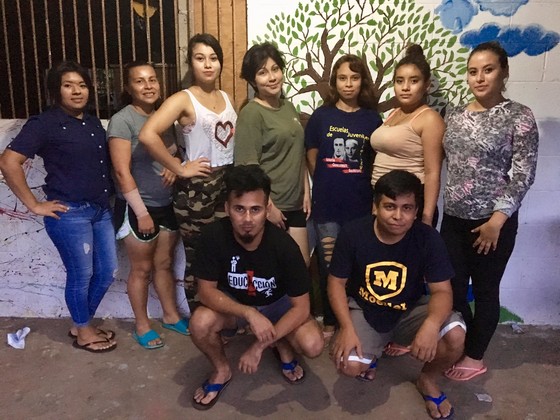
Scholarship
students at semi-annual meeting in discussion group
|
Twice each year I travel to El
Salvador and meet with most of the students either at large regional
meetings or through visits to the more isolated communities.
During these meetings we review the
student grades and talk about developing
good reading habits. We bring good Spanish literature with us that we
check out to the students. Most of the kids cannot afford books. Sometimes
at these meetings we have guest speakers who give motivational
presentations.
|
Scholarship
journalism student Melissa. She wants
to become a TV anchorwoman
|
It has been only in the past 6 years
that we have begun to focus on providing scholarships for a
university education. Just under 90 percent of the 41 university level students
are women. Two of the women have embarked on an 8-year program to
become doctors. One man is studying
to become a dentist, also an 8-year
commitment. Other young ladies are
studying in the fields of education,
sociology, journalism, social work, nursing, law, English, psychology,
accounting, and public relations. I mentioned at the beginning that
eight students have graduated. They received degrees in the subjects of
forestry, mechanics, accounting, and physical therapy.
|
Scholarship
student Roxana is studying to be a surgical nurse
|
Project Salvador has proudly
supported a young lady who is currently studying for her doctorate in
primatology with a scholarship provided by the German government. We provided a
good portion of the funding she needed to get her Master’s degree.
When she graduates she will be the only primatologist in El Salvador
and very qualified for university level teaching or a position with the
Ministry of the Environment.
|
Yesenia
physical therapy student working in child rehabilitation clinic
|
Education is so important for a
better world particularly with regards to the education of girls. “Some 58
million girls in the developing world are not in school. Whether or not a
girl goes to school can be a life or death matter. In comparison to her
educated counterparts, an unschooled girl is more likely to be poor,
marry early, die in childbirth, lose a child to sickness or disease, have many
births closely spaced and have children who are chronically ill or
malnourished. In contrast, a girl who goes to school and stays there is much more
likely to delay marriage and childbirth and have fewer, healthier
and better-educated children. These benefits have a ripple effect
throughout society as a whole. In fact, if you keep girls in school you can change
the course of a nation.”(Save the Children-2005).
If you teach a boy you educate an individual; but if you teach a girl, you educate a community. African Proverb
|
High
school scholarship students from the village of Loma del Muerto taking
advantage of a donated desktop computer.
|
University
scholarship student Marjeri shows her
computer graphics skills
|
If you care to donate please make your check out to the
“Project Salvador Scholarship Program” and send it to Tony Gasbarro, Project
Salvador, 2687 Horsetail Trail, Fairbanks, Alaska. Project Salvador’s
headquarters is in Denver, Colorado but since we have only one paid staff
member to keep our operating costs down, board members take charge of various
projects. Mr. Gasbarro is coordinator of the scholarship program and can be reached
by either sending him an email by clicking on the following envelope or at 907-455-6287 for further information.
|
Sonia (left) and Johana
medical students studying at Alberto
Monsferrer
University in San Salvador, El Salvador
|
University
scholarship students from the northern part of El Salvador
|
Rural
scholarship student Guadalupe with mom
and dad
|
9th
grade student Orbelina has a great interest in reading
|
Heidi
giving presentation to high school class
|
Mr. Gasbarro is coordinator of the scholarship program and can be reached
by either sending him an email by clicking on the following envelope or at 907-455-6287 for further information.
|
|
|